One Camera, Several Perspectives: Choosing a Point of View
Choosing a point of view for a local film helps you balance intimacy with context, so a small story feels personal without losing the people around it.
The most common mistake in choosing a point of view for a local film is to stay close to the most expressive person simply because they make compelling footage. The result can feel intimate, but it may leave viewers unsure how that person fits into the place or community around them. A camera’s distance is also a decision about whose knowledge the film trusts.
For a small story—a volunteer-run repair café, a neighborhood garden, a family shop facing a change—three approaches offer different kinds of access: close, observational, and shared. None is automatically more honest. The useful question is what the audience needs to understand, and who should be able to shape that understanding.
Close point of view makes one person the guide
A close point of view follows one person’s experience through conversation, action, and the details they notice. The film may stay with a baker opening a shop, a teenager preparing for a local performance, or a caretaker tending a community space. The subject’s choices give the story a clear line through the day.
This approach suits a story where private stakes matter: uncertainty about a decision, pride in a skill, or the effort behind a familiar public role. A small crew can often work quietly with a camera, a microphone, and a subject who understands what filming involves. Close framing can make gestures legible—the pause before a phone call, flour brushed from a sleeve—without asking a busy room to perform for the lens.
The tradeoff is that the subject’s perspective can become the film’s whole map. A shop owner may describe a changing street from the doorway, but that account cannot stand in for every neighbor’s view. The filmmaker can keep the story personal while making its boundaries clear: distinguish what the subject says from what the film independently establishes, and avoid presenting one person as a spokesperson for a whole place.
Observational point of view gives the room more say
An observational approach follows activity with less direct explanation. The camera watches people work, wait, disagree, or make decisions, while the edit builds meaning from what happens. In a community kitchen, for instance, a shared task can reveal who coordinates, who improvises, and where friction appears—details a formal interview might smooth over.
This approach suits a story whose relationships and routines matter as much as any one person’s account. It can bring context through visible interaction rather than a running explanation. The filmmaker still shapes the film by choosing where to stand, when to roll, what to keep, and whose actions make the final cut. “Just observing” is not the same as having no point of view.
Observation also asks for patience and a suitable setting. People may become self-conscious, important events may happen outside the camera’s reach, and an uncaptioned exchange may be hard for viewers to interpret. Before filming, explain the project in plain language, discuss boundaries with participants, and consider how filming could affect people who are present but not central to the story. The specific permissions and requirements depend on the location and circumstances.
Shared point of view lets people shape the account
A shared approach gives more than one participant a meaningful role in defining what the story is about. That might mean following several people whose responsibilities overlap, inviting participants to identify important moments, or checking whether the edit has made a complex exchange misleading. The camera remains the filmmaker’s tool, but its account is informed by more than one person’s priorities.
This can suit a local story with several legitimate perspectives: residents deciding how to use a shared room, members of a volunteer group dividing labor, or neighbors responding differently to a proposed change. A shared approach can keep the film from confusing the most confident speaker with the only person who matters. It can also reveal that the disagreement is not simply about opposing opinions; people may be working from different needs or responsibilities.
Sharing perspective takes time and care. Participants do not need to agree on the film’s meaning, and consultation does not require handing over every editorial decision. Set expectations early about what participants can influence, how feedback will be gathered, and what remains the filmmaker’s responsibility. Avoid inviting input only after the story has been fixed; at that point, consultation can feel like a request to endorse a decision already made.
How can you choose the right point of view?
When does a close point of view fit?
Choose it when one person’s experience is the clearest route into the story and the film can stay honest about what that person knows. Ask whether viewers can understand the wider situation without treating this participant as a stand-in for everyone else.
When is observation more useful?
Choose it when relationships, routines, or decisions unfolding in a shared space carry the story. If viewers would need background to understand what they see, plan a way to provide that context rather than assuming images will explain themselves.
What does a shared point of view require?
It requires clear conversations about participation and a workable way to hear people whose roles differ. If you cannot give that process enough time, keep the scope narrower and be transparent about whose perspective the film follows.
Can a small film combine approaches?
Yes, if each shift has a reason. A film might follow one organizer closely during a difficult week, then step back during a meeting so the audience can hear how others respond; the change should clarify the story, not merely add variety.
Choose by the audience’s missing piece
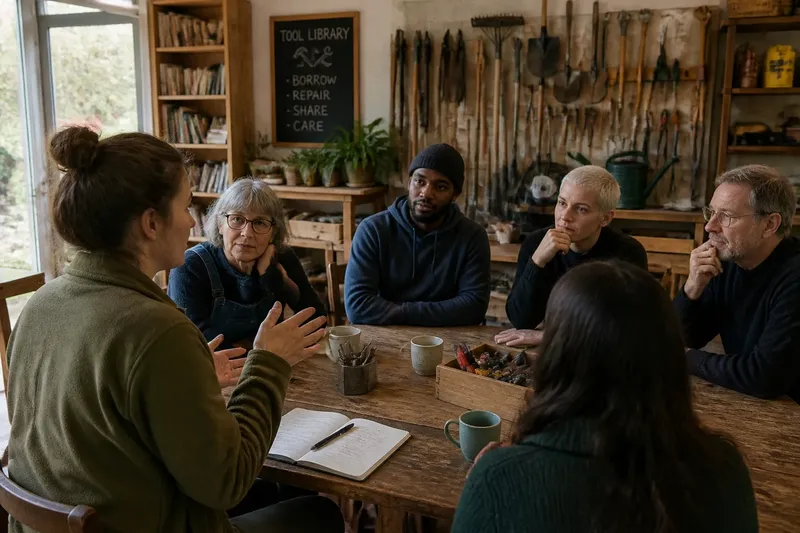
Imagine you are filming a neighborhood tool library as its volunteers decide whether to open on another evening. You begin by following the volunteer who handles the schedule, then notice that the decision depends on members’ different work hours and on who can close the space. A close approach would carry the scheduler’s pressure; observation could show the discussion; a shared approach could bring forward the members’ separate needs. The expected result is not a universally correct answer, but a clearer view of what each choice lets the audience know.
Before filming, write down what viewers must understand and whose experience could supply it. If the missing piece is emotional texture, stay close. If it is a relationship in action, make room to observe. If the story’s meaning depends on competing needs, share the frame and the process more deliberately.
What is not worth the effort is forcing a film into a supposedly neutral style or adding extra voices just to make it appear balanced. A precise, limited point of view can be more revealing than a crowded one. Choosing a point of view for a local film is ultimately choosing which kind of understanding the camera can responsibly offer—and where the story should admit what it cannot see.