Before the Local Film Club, Shared Screenings Need a Reason to Return
Shared screenings become a local film club when each selection carries a thread forward. Learn how to preserve continuity, adapt the program, and keep its history useful.
The common mistake with shared screenings is treating each one as a fresh event; the cost is that a good evening leaves no trace in the next one. A local film club takes shape when its choices begin to carry a memory forward: a recurring subject, a filmmaker whose work returns, or a question that changes as the films do.
Continuity does not mean repeating the same format or taste. It means giving the group a history that helps explain what it is watching now and offers a useful starting point for what comes next. A modest record and a deliberate programming thread can do that without turning a neighborhood screening into an institution.
A local film club needs a thread viewers can recognize
Variety can keep a program lively, but unrelated choices may leave returning viewers unsure what connects one gathering to another. A thread gives selections context: regional work, films about labor, or stories set in places undergoing change. It should guide choices, not dictate them.
Make the thread visible in the program note or invitation. A short explanation can connect a new film to the previous one while making clear that the series is still open to discovery. If the connection becomes strained, change the thread rather than forcing a film to fit.
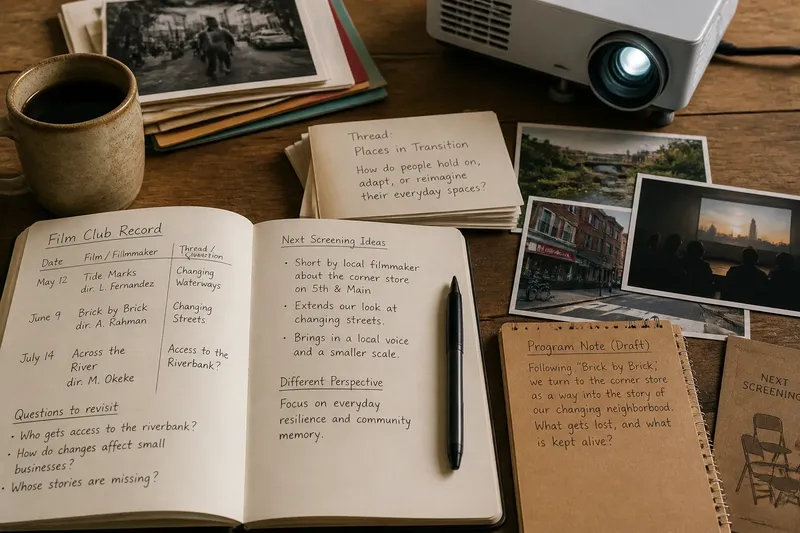
Say a neighborhood group has shown two films about changing streets and is choosing what follows. Its organizers select an imagined short by a local filmmaker about a corner store, explain how it extends the series, and note one different perspective it brings. The observable result is a program description that tells returning viewers why the film belongs and gives newcomers a clear point of entry; the choice still leaves room for another direction afterward.
Carry one useful trace from each screening into the next
Continuity becomes more than a theme when the group remembers something specific from its previous gathering. Keep a short record of the title, filmmaker, program thread, and a question or detail people wanted to revisit. A shared document or paper notebook is enough; an elaborate archive is not worth the effort unless someone has a clear reason to maintain it.
Use the record as a prompt, not a syllabus. A later film might echo a sound, setting, or unresolved tension from an earlier one, or it might challenge the group’s assumptions about that subject. The connection can be introduced in a sentence before the screening, then left for viewers to notice or reject.
Imagine a volunteer is choosing a follow-up after an invented screening about local waterways. The notes mention that viewers wondered who gets access to the riverbank; the volunteer selects an imagined regional documentary about public paths and adds that question to the program note. The resulting link is concrete, while the new film can complicate the earlier conversation instead of merely repeating it.
Change the series when its familiar pattern stops helping
A recurring format can become stale if it keeps producing the same kind of program or favors only the most familiar voices. Look at the record for repeated subjects, filmmakers, places, and formats. The point is not to enforce variety for its own sake, but to notice when a habit has narrowed the series.
- If several recent selections share the same subject, then choose a film that complicates it; otherwise, keep the subject and vary the perspective.
- If the program relies on one format, such as documentary, then consider fiction or animation; otherwise, retain the format if it still serves the thread.
- If the same filmmaker appears repeatedly, then give another regional filmmaker space; otherwise, continue the focus if the return adds a meaningful new work.
- If program notes assume knowledge of earlier screenings, then add a brief link for newcomers; otherwise, keep the note concise.
- If a recurring theme feels forced against a proposed film, then revise the theme or choose another title; otherwise, explain the connection plainly.
- If organizers cannot maintain the record, then reduce it to titles and one useful note; otherwise, preserve the detail that supports future choices.
Each decision should serve the program’s memory, not a rulebook. A deliberate return to a filmmaker can be more revealing than a novelty pick, and a change in format matters only if it opens a useful path through the series.
Make the club’s history legible to people arriving later
Regular viewers develop shorthand: a familiar director, a past debate, or a theme that needs no explanation among friends. For someone attending for the first time, that history can feel like a closed conversation. A brief note about the series’ thread gives newcomers context without asking them to catch up on every prior screening.
Keep a public-facing record simple and selective. A list of past titles and a line about each program’s connection can show how the series has developed. Avoid treating the record as a verdict on what the community likes; it documents choices, not every viewer’s response.
How should a screening series preserve continuity?
What should a screening group record?
Keep the film title, filmmaker, date or program entry, and a short note on the thread or question that linked it to the series. Add only details someone can use when choosing or introducing a later screening.
How can a group revisit a filmmaker without repeating itself?
Choose a different work, period, or approach from that filmmaker’s output, and explain what the return helps the series notice. If the connection adds nothing new, select another filmmaker or let the thread move on.
What if a screening does not fit the series theme?
Check whether the film offers a genuine counterpoint or whether the theme has become too restrictive. If the connection needs a long defense, revise the theme or choose a better-fitting film rather than disguising the mismatch.
Does a film club need a formal archive?
No. A shared note or straightforward list can preserve enough context for future programming. Build a larger archive only if the group has a clear purpose and someone willing to care for it.
Keep the series recognizable without making it rigid
It is not worth the effort to create elaborate rituals or polish every screening into a premiere. A concise program note and a reliable record can preserve continuity while leaving the films room to surprise the group.
For a local film club, the useful test is whether its history helps someone understand the present choice without dictating the next one. Keep the connections that illuminate a film, revise the ones that have gone stale, and let the record serve the program rather than the other way around.