A Screening Is a Sequence, Not Just a Film
A community film screening sequence can feel coherent without feeling overproduced: give the welcome, transitions, and film order distinct jobs.
The most common mistake in a community screening is treating the films as the whole event and adding a welcome, a few pauses, and an ending at the last minute. That can leave the audience unsure when to settle in, why the films sit together, or whether the night is over. A thoughtful screening sequence gives every element a clear job, so the films have room to speak and the event feels held together without becoming a performance about itself.
That does not mean building an elaborate theme or scripting every breath. The useful work is more modest: decide what the opening needs to do, what each transition should help the room do, and what order lets the program develop. A simple plan made during the week before the event is usually enough to keep those choices visible.
A community screening sequence starts with three distinct jobs
Before choosing a running order, write down what the non-film moments are for. A welcome, a transition, and a closing can all contain words, but they should not all deliver the same information or demand the same kind of attention.
- Opening remarks orient. They tell people what kind of event they have entered, explain any practical details they need, and give the room permission to settle.
- Transitions reset attention. They help the audience cross from one film to the next, especially when tone, subject, format, or mood changes sharply.
- The order creates movement. It shapes how the films relate and how the audience’s attention changes across the program.
- The close releases the room. It makes clear whether people should stay for a conversation, move to another space, or simply take the ending with them.
When a moment has no distinct job, it is a candidate for trimming. A welcome that repeats the printed program, introduces every filmmaker, explains the venue, and previews the discussion is trying to do too much. Choose the essential information for the room, then let the rest live in the program notes or a later conversation.
One week out, choose the shape before polishing the words
Start with the actual films, not an abstract idea of what a good program ought to feel like. Note each film’s tone, pace, subject, visual texture, and the kind of attention it asks from viewers. A quiet observational piece and a brisk comedy may sit together beautifully, but the audience needs a little space to make that turn.
Then consider the room and occasion. A library meeting room, an arts center, and a neighborhood hall each have their own rhythms: people may arrive in a rush after work, find seats while lights are already dimming, or need a clear cue before the first image. Account for practical realities without making them the program’s whole identity.
Make a rough running order on paper. For each film, write one sentence describing what it contributes at that point in the evening. If the only reason for a placement is “it was the first file we received,” keep arranging. A sequence should feel chosen, even if its logic is subtle.
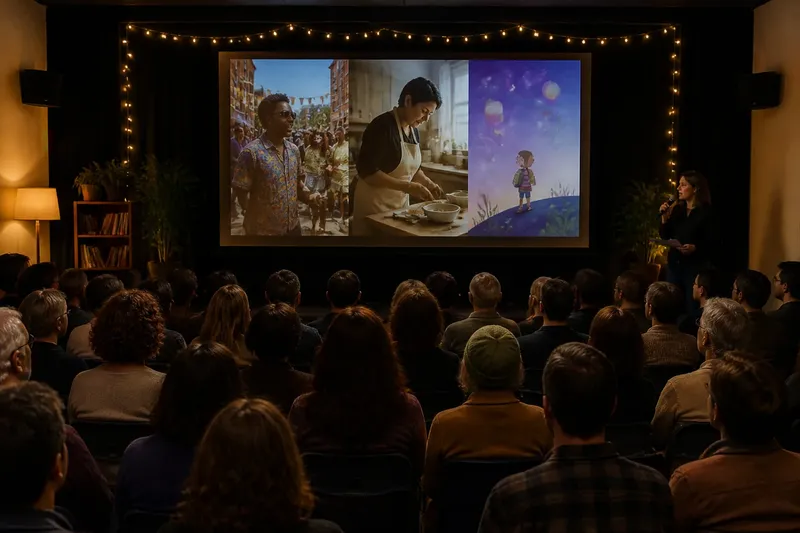
Imagine a neighborhood program with three short films: a lively street-corner portrait, a reflective piece about a family recipe, and a playful animation about getting lost. The organizer might open with the street-corner film to bring the room in, place the recipe film in the middle to slow the pace, and end with the animation’s buoyant energy. The observable aim is a program that changes register deliberately, rather than one that simply moves from file to file.
Several days out, give every film a reason for its place
Test the order by asking what one film leaves the audience holding and what the next one asks them to notice. The answer need not be a shared subject. A shift from a crowded, talkative film to an intimate, nearly wordless one can create a useful contrast; a pair of similarly paced films can instead let viewers settle into a particular texture.
Think about the opening and final positions with special care. The first film has to meet an audience that may still be arriving mentally, even if the doors are closed. The last film has to leave the room somewhere: with a question, a laugh, a striking image, or a feeling of completion. None of these is automatically best. Choose according to the program’s character, not a rule that every event must begin big or end uplifting.
Also look for collisions that might be accidental rather than expressive. Two films with similar titles or repeated images may appear to answer each other, even if their makers intended no connection. That can be an intriguing pairing, but the organizer should know the effect is there and decide whether to acknowledge it or leave it open.
Do not force a neat arc onto unrelated work. A community program can include films that disagree, wander, or resist a single interpretation. The sequence’s job is to make those differences legible enough for the audience to stay curious, not to pretend every film is one chapter of the same story.
Write an opening that welcomes without taking the first film’s space
Draft the welcome after the order is settled. Keep its language conversational and its tasks limited: greet the room, name the event, explain essential logistics, and offer a brief reason the films are being shown together. The filmmaker biographies, long acknowledgments, and full plot descriptions can wait for the printed program, a short introduction before a particular film, or a discussion afterward.
Make the practical details easy to hear. Tell people where the exits and restrooms are if that information is useful, whether latecomers should wait for a pause, and what to expect after the final film. If the screening includes an accessible version, captions, or a quiet space, explain what viewers need to know plainly and without turning the welcome into a list of institutional claims.
Then stop before the room’s attention starts to drift. The audience came to see the films; an opening should make that easier. If a sentence mainly demonstrates how much the organizer knows, it probably belongs somewhere else.
Use transitions only where the audience needs a change of gear
A transition can be a spoken sentence, a moment of silence, a change in lighting, or simply a clean pause before the next film. Choose the lightest option that helps the room. A lively introduction before every short can make the program feel over-managed, while an abrupt tonal jump may leave viewers searching for a connection the organizer never meant to imply.
When you do speak, name the change without explaining away the film. “We’re moving from a crowded public space to a much quieter, domestic one” gives viewers a small handrail. A mini-review that tells them what to feel, or a plot summary that pre-interprets the work, takes away the pleasure of meeting it themselves.
Transitions can also clarify logistics: a pause for people to stretch, a reset while a file loads, or a reminder that a short conversation follows. Make the pause purposeful and predictable. If a technical delay occurs, a calm, brief update is more helpful than filling the time with improvised commentary.
During the final week, rehearse the handoffs rather than every gesture
A few days before the screening, read the running order aloud with the transitions included. This catches repeated information and awkward phrases, and it makes the total rhythm easier to imagine. Check names and pronunciations with the people involved rather than guessing from a program sheet.
Before the event, confirm the practical handoffs with whoever is operating projection and sound. Agree on the cue for lights down, who introduces the first film, how the next file begins, and what happens if the program needs a pause. This is coordination, not a demand that the evening run like a stage show; clarity lets everyone pay attention to the room.
It is not worth the effort to choreograph every step to the lectern, write several versions of the same welcome, or add music to every gap simply because silence feels exposed. Those additions can make a small screening feel self-conscious. Spend that time checking the order, the cues, and the audience information instead.
What should opening remarks, transitions, and film order do?
How long should opening remarks be?
Long enough to welcome the room, cover essential logistics, and explain the program’s basic premise; short enough that the first film still feels like the main event. If useful background cannot fit comfortably, put it in a printed note or save it for a later conversation.
Should every short film have an introduction?
No. Introduce a film when context helps viewers enter it or when a major shift needs a handoff, not just to fill the space before projection. A deliberate pause can be a clearer transition than another speech.
How should a community screening order its films?
Consider tone, pace, subject, and the kind of attention each film asks for, then decide what each position contributes. The strongest order is not necessarily the one with the most dramatic opening or neatest ending; it is the one whose changes feel considered.
What should the host say between films?
Say only what helps viewers cross into the next part of the program: a useful tonal cue, practical information, or a clear invitation to pause. Avoid plot summaries and instructions about what the audience should think.
On screening day, let the plan serve the room
Arrive with a printed running order for the host and projection operator. Mark who speaks, where each film begins, and any planned pause. Keep a copy near the playback controls so that an unexpected interruption does not force the team to reconstruct the sequence from memory.
As people arrive, notice the room without changing the program for every small fluctuation. If latecomers are still finding seats, a clear welcome can help them settle; if the audience is ready, there is no benefit in stretching the opening. A plan gives the host a steady reference, not a command to ignore what is happening.
After the last film, make the next action unmistakable. If a discussion is coming, say who will guide it and how people can join. If the event ends there, thank the room and point out any practical next step, such as returning borrowed chairs or collecting belongings. The final words should open the door to what actually happens next.
Keep a short note for the next screening
After the event, record a few observations while the sequence is still fresh. Note where the audience needed more time, which transition felt unnecessary, whether the closing cue was clear, and any technical handoff that caused confusion. These details are more useful than a vague verdict that the night went well or badly.
For the next community screening sequence, change one element at a time when possible. If the order felt lopsided, rearrange the films; if the welcome ran long, cut its extra duties rather than stripping out the information people needed. That keeps the event’s decisions visible and helps each new program find its own rhythm.
A screening is not improved by adding more ceremony. It becomes easier to follow when the welcome, transitions, and film order each do their own work, leaving viewers free to meet the films on their own terms.